Abacus for Children: A Parent's Guide
Thinking about abacus for your child? This page covers the right age, how to practise together at home, what to ask if you choose a class, and when to take a break.
What is the right age?
| Age | What to expect |
|---|---|
| Under 5 | Counting frames and bead games are fine. Formal soroban work is usually too early. |
| 5–7 | The most common starting age (roughly Class UKG to 2). Progress is slower but steady. |
| 8–10 | Often moves faster through early levels. Still time to reach mental levels. |
| 11 and up | Can still learn, but may prefer Vedic Maths or school-focused practice. |
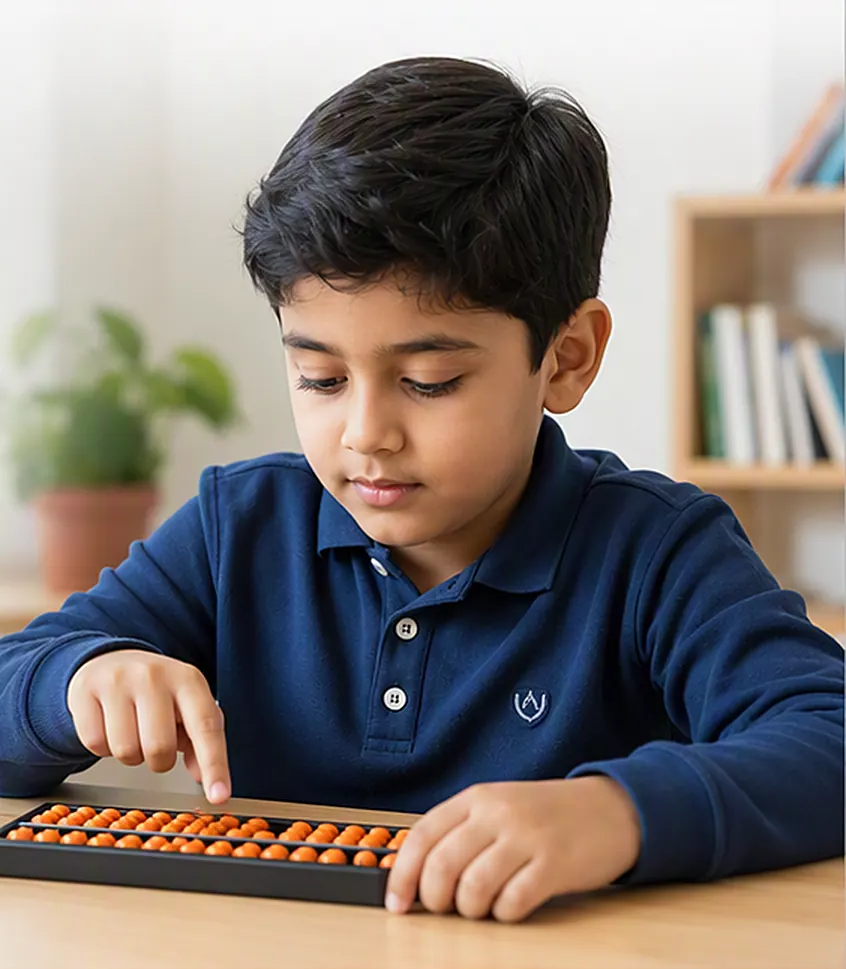
Signs your child is ready
- Counts to 20 and recognises written numbers
- Can sit for a 15–20 minute activity
- Uses fingers to pick up small objects (fine motor control)
- Is curious about numbers, or at least not anxious about them
Practise together at home: a 4-week start
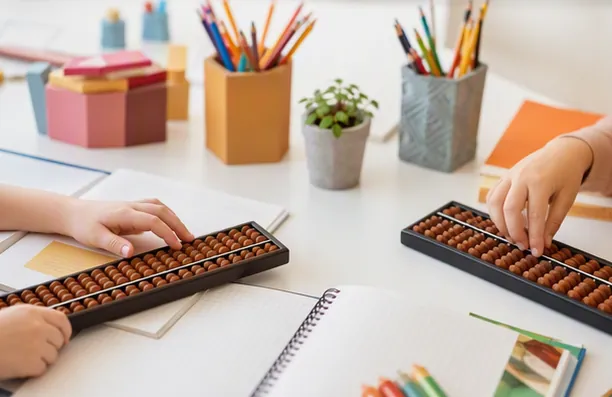
You don't need to be good at maths to start. Read the how-it-works guide once, keep a few minutes ahead of your child, and practise together. These four weeks cover what most classes teach in the first months.
Keep sessions to 10–15 minutes and stop while it's still fun. If a week feels hard, repeat it.
| Week | Focus | Try this together | Tools on this site |
|---|---|---|---|
| 1 | Meet the abacus | Name the parts, then set and clear numbers from 0 to 99 | Practice abacus, Set the number (1–2 rods) |
| 2 | Direct adding and subtracting | Sums like 3 + 5 and 8 − 6, where the beads are free | Quick sums Level 1 |
| 3 | Small friends (make 5) | 4 + 1 done as +5 −4; say the rule out loud | Worksheet Level 1 |
| 4 | Big friends (make 10) | 7 + 5 done as +10 −5 on two rods | Worksheet Level 2, Practice Game Easy |
- Swap roles. Let your child set a number for you to read. Teaching helps them remember.
- Use the same time each day, such as after school snacks or before dinner.
- Praise the method, not the speed. "You used big friends there" works better than "That was fast".
When school and abacus methods clash
- Tell your child both are right: abacus works left to right, school written sums usually go right to left. Most children settle within a few weeks.
- Ask your child to show you a sum both ways. Explaining helps them see the link.
- Use the free practice tools for variety.
If you're thinking about a class
A class isn't required, but some families like the routine and the group. If you're looking at one, these are worth asking about:
| Ask about | A good sign |
|---|---|
| Batch size | About 6 to 12 children |
| Trial class | Free or low-cost trial before you pay for a level |
| Teacher training | Teachers who've completed the programme themselves |
| Tests and repeats | Weak topics are repeated, not skipped |
| Homework | 10–15 minutes a day, not an hour |
| Claims | Talks about arithmetic, not "IQ" or "right brain" |
The soroban used in most classes is described on the types of abacus section.
What it costs
Home practice costs very little: a student soroban (about ₹150–₹500) plus free worksheets and tools. If you choose a class, fees vary a lot by city and brand. As a rough guide, many centres in Indian cities charge somewhere between ₹1,000 and ₹3,000 a month, or ₹3,000 to ₹8,000 per level, plus registration, kit and exam fees. Ask for the full cost of all levels before you join.
When to pause or stop
Consider a break if your child complains about practice for weeks on end, gets upset before sessions, or falls behind in school work because of the extra load. A pause of a few weeks or a term is common, and most children can pick up again later.
Abacus is one option among many. Good school teaching, board games, cooking and shopping maths also build number sense.