What Is an Abacus? Meaning, Parts, Types and History
An abacus is a counting frame: beads slide along rods, and each rod stands for one place value. It's one of the oldest calculating tools and is still used to teach arithmetic.
Abacus meaning
The word comes from Latin abacus and Greek abax, meaning a flat board or tablet. Early versions were boards covered with sand or lined with grooves where pebbles were moved. The bead-and-rod frame came later.
Today the word usually means a rectangular frame with rods and sliding beads. In Hindi you'll often hear it called abacus as well, or described as a ginti ka yantra (counting tool).
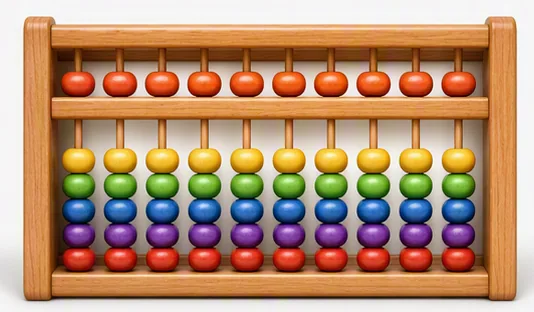
Parts of an abacus
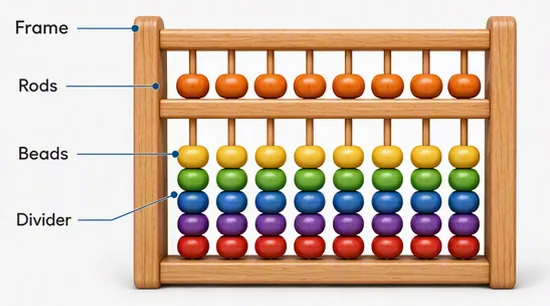
| Part | What it does |
|---|---|
| Frame | Holds the rods. Usually wood or plastic. |
| Rods (columns) | Each rod is one place value. The rightmost rod you choose is ones, then tens to its left, and so on. Student sorobans have 13, 15, 17 or 23 rods. |
| Beam (reckoning bar) | The bar that splits each rod into two decks. Beads count only when pushed against it. |
| Heaven bead | The single bead above the beam. Worth 5. |
| Earth beads | The four beads below the beam. Worth 1 each. |
| Unit dots | Dots on the beam every third rod. They help you find the ones rod and read large numbers. |
You can try this on the interactive soroban on the how-it-works page.
Types of abacus
| Type | Beads per rod | Where it's used |
|---|---|---|
| Soroban (Japan) | 1 above, 4 below | Most abacus classes in India, Japan and worldwide |
| Suanpan (China) | 2 above, 5 below | Traditional Chinese calculation; also works with base 16 |
| Schoty (Russia) | 10 per wire, no beam | Shops and schools in Russia until the 1990s |
| Rekenrek / counting frame | 10 per row, often in two colours | Pre-school and early primary number sense |
| Cranmer abacus | Soroban layout, beads held by friction | Blind and visually impaired students |
If you're buying one for classes, choose a soroban with at least 13 rods. The buying guide on the practice page has more detail.
A short history
Counting boards were used in Mesopotamia, Egypt, Greece and Rome, where merchants moved pebbles (Latin calculi, which gives us the word calculate) across marked lines. The Salamis tablet, a marble counting board found in Greece, dates from around 300 BCE.
The Chinese suanpan was in wide use by the 1300s. It reached Japan around the 1500s, where it became the soroban. Japan moved to the one-bead-above, four-below design in the 1930s, and that's the design most learners use now.
In 1946 a Japanese soroban expert, Kiyoshi Matsuzaki, beat a US Army clerk using an electric calculator in a public contest in Tokyo in four of five rounds. The event is still quoted as an example of how fast a trained abacus user can be.
Abacus classes have become popular in India over the last two decades or so, mostly as after-school programmes for primary school children.
Key terms
| Term | Meaning |
|---|---|
| Anzan | Mental calculation using a pictured abacus. Also called mental abacus. |
| Small friends | Pairs that make 5 (1+4, 2+3). Used when a rod runs out of earth beads. |
| Big friends | Pairs that make 10 (1+9, 2+8, 3+7, 4+6, 5+5). Used when a rod overflows. |
| Flash anzan | Adding numbers that flash on a screen for a fraction of a second each. |
| Level | A stage in a class programme, usually lasting 3 to 4 months. |
Next, learn how small friends and big friends work in real sums.