Abacus Tutorial for Parents & Beginners: Step by Step
How do I start learning the abacus?
Start with the eight short tutorial steps — from what the beads mean to carrying — and try each step on the on-screen abacus as you go.
Never used an abacus? Start here. Eight short steps take you from what one bead means to carrying in addition, with a picture for every move and a free on-screen abacus to try each example.
By AbacusBrainy · Updated
Step 1 · Understand the abacus
Level 1Level 2
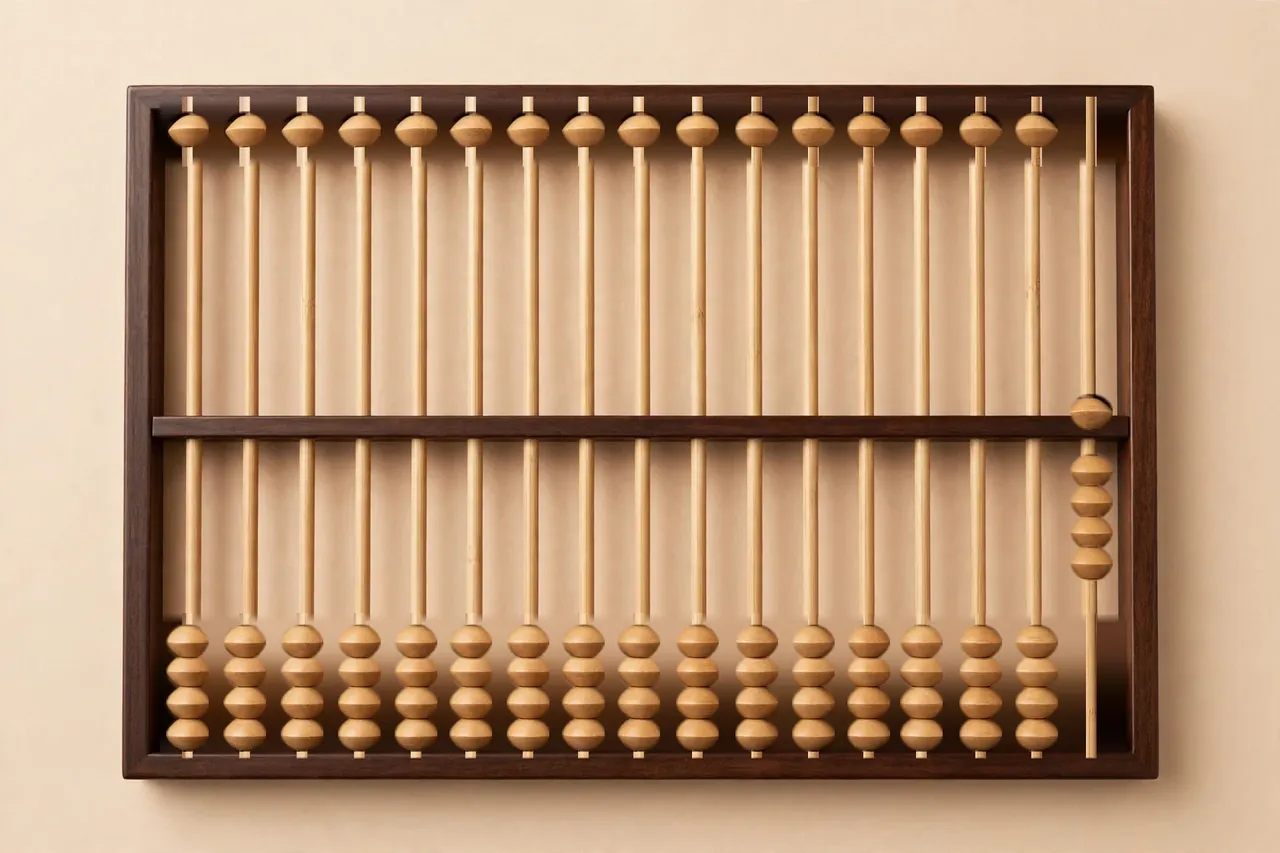
An abacus is a frame with vertical rods. Beads slide up and down each rod. A bar across the middle, the centre bar, splits every rod into an upper part and a lower part.
Each rod shows one digit, from 0 to 9. To begin, look at just one rod.
This rod shows 7: the upper bead (5) and two lower beads (1 + 1) touch the centre bar. The two faded beads are away from the bar, so they don't count.
The one rule to rememberOnly beads touching the centre bar are counted. A bead pushed away from the bar is worth nothing.
How to read one rod
Look above the bar. Is the upper bead touching it? If yes, start at 5. If not, start at 0.
Look below the bar. Count the lower beads touching it and add 1 for each.
That total is the digit on the rod. With one upper bead and four lower beads, a rod can show anything from 0 to 9.
Numbers 0 to 9 on one rod
0nothing touches the bar1one lower bead2two lower beads3three lower beads4four lower beads5upper bead6upper bead + one lower bead7upper bead + two lower beads8upper bead + three lower beads9upper bead + four lower beads
Check yourself: cover the words under each picture and say the number out loud. When you can read all ten, you've finished Levels 1 and 2.
One rod can only hold one digit. For bigger numbers you use more rods, and each rod has its own place value. Each step to the left is worth ten times more.
Ones×10 →Tens×10 →Hundreds×10 →Thousands
On the abacus these run from right to left: the ones rod is on the far right, tens to its left, then hundreds, then thousands. So you read a number from left to right, just as you write it.
8
8 = 8 ones
10
10 = 1 ten + 0 ones
23
23 = 2 tens + 3 ones
125
125 = 1 hundred + 2 tens + 5 ones
Why the empty rod mattersIn 10, the ones rod is empty: every bead is away from the bar. That empty rod shows 0 ones. Without it, the 1 would mean just 1 one.
On the on-screen abacus, the letters under the rods tell you each place: O = ones, T = tens, H = hundreds, K = thousands, 10K = ten thousands, L = lakhs, 10L = ten lakhs.
Step 3 · Set numbers on the tool
Level 2Level 3Level 4
Now put Steps 1 and 2 together on the on-screen abacus. For each number: say it, split it into place values, then move the beads rod by rod. On the on-screen abacus, the ones rod is the one on the far right, labelled O.
How the on-screen abacus works
The big number at the top always shows what the beads say, in figures and in words. Use it to check yourself.
Lower beads are counted from the bar: the 1st lower bead is the one next to the bar, the 4th is the one furthest away.
Lower beads: tap the bead that should be the last one touching the bar. The beads between it and the bar move with it. Tap a bead that's already at the bar to push it, and the beads below it, away.
Upper bead: tap it to bring it down to the bar (5). Tap it again to push it back up (0).
Clear sets every rod back to 0. To check an answer, type a number and press Show on abacus.
Five numbers to set
Set the number 4
Number
4
Place values
4 ones
Beads on each rod
Ones rod: tap the 4th lower bead. All four lower beads move up to the bar.
Today's goal: Set any number from 0 to 9 on a rod quickly and correctly — clear the rod first, then decide: the heaven bead or not, and how many earth beads.
Parents: how to teach
Always clear the rod before setting a new number.
Ask two questions: "Do I need the heaven bead?" and "How many earth beads?"
Set the heaven bead first, then the earth beads.
Practise on the on-screen abacus too: type a number and compare.
Time a round of ten numbers only once every setting is correct.
Use your abacus to find each answer, then write it.
Set 0. How many earth beads touch the beam?
Set 1. How many earth beads touch the beam?
Set 2. How many earth beads touch the beam?
Set 3. How many earth beads touch the beam?
Set 4. How many earth beads touch the beam?
Set 5. How many earth beads touch the beam?
Set 6. How many earth beads touch the beam?
Set 7. How many earth beads touch the beam?
Set 8. How many earth beads touch the beam?
Set 9. How many earth beads touch the beam?
Set 3. How many beads touch the beam altogether?
Set 5. How many beads touch the beam altogether?
Set 6. How many beads touch the beam altogether?
Set 7. How many beads touch the beam altogether?
Set 8. How many beads touch the beam altogether?
Set 9. How many beads touch the beam altogether?
Heaven bead down, 1 earth beads up. Which number did you set?
Heaven bead down, 2 earth beads up. Which number did you set?
Heaven bead down, 3 earth beads up. Which number did you set?
Heaven bead down, 4 earth beads up. Which number did you set?
For parents: answer key
Answer Key — Lesson F4 (for parents)
Set 0. How many earth beads touch the beam? 0
Set 1. How many earth beads touch the beam? 1
Set 2. How many earth beads touch the beam? 2
Set 3. How many earth beads touch the beam? 3
Set 4. How many earth beads touch the beam? 4
Set 5. How many earth beads touch the beam? 0
Set 6. How many earth beads touch the beam? 1
Set 7. How many earth beads touch the beam? 2
Set 8. How many earth beads touch the beam? 3
Set 9. How many earth beads touch the beam? 4
Set 3. How many beads touch the beam altogether? 3
Set 5. How many beads touch the beam altogether? 1
Set 6. How many beads touch the beam altogether? 2
Set 7. How many beads touch the beam altogether? 3
Set 8. How many beads touch the beam altogether? 4
Set 9. How many beads touch the beam altogether? 5
Heaven bead down, 1 earth beads up. Which number did you set? 6
Heaven bead down, 2 earth beads up. Which number did you set? 7
Heaven bead down, 3 earth beads up. Which number did you set? 8
Heaven bead down, 4 earth beads up. Which number did you set? 9
Ready for the next lesson when: any number from 0 to 9 is set at once, starting from a clear rod, and 8 or more out of 10 are right in the practice box or on the worksheet.
Step 4 · Addition on one rod
Level 5
Adding on the abacus means moving more beads to the centre bar. Before you think about beads, think of it as a short story: you start with a number, you add some more, and you finish with a bigger number.
Start4
→
ActionAdd 4 more
→
Result8
When there are free beads, just push them up
Start with the easiest case: 2 + 2. The rod shows 2 and two more lower beads are free, so you simply push them up to the bar.
Before2
Action
+2
Tap the 4th lower bead. It moves up to the bar together with the bead above it.
After4
Green outline and arrow = a bead that moved. Faded beads are away from the bar.
Stuck on a move?Type the number you're adding in the box and press + Add. The tool shows where the beads should end up, and you can copy it with your fingers.
Step 5 · Two-digit addition
Level 5
With two-digit numbers, each digit is added on its own rod: tens on the tens rod, ones on the ones rod. Abacus users start with the biggest place, on the left, then move right.
Example: 23 + 14 = 37.
TensOnes
Start23
Add+1+4
Result37
Before23
Action
Tens rod: +1
Tap the 3rd lower bead (2 → 3).
Ones rod: +4
Tap the upper bead (+5), then tap the 3rd lower bead to push it away (−1). 3 → 7.
After37
Green outline and arrow = a bead that moved. Faded beads are away from the bar.
The ones rod used exactly the same move as 4 + 4 in Step 4. Nothing new: just one rod at a time.
One rod can only show up to 9. When a sum on a rod would go past 9, you make a group of ten and move it to the next rod on the left as one bead. This is called carrying, or regrouping. It's the same idea as carrying in written sums at school.
Example: 8 + 5 = 13.
The ones rod starts at 8.
Add 5. In your head, that's 8 + 5 = 13 ones.
13 ones won't fit on one rod. 10 of those ones make 1 ten.
So the tens rod goes up by 1, and the ones rod keeps the other 3.
Result: 1 ten and 3 ones = 13.
Before8
Action
Tens rod: +1 (that's +10)
Tap the 1st lower bead.
Ones rod: −5
Tap the upper bead to push it away. The three lower beads stay.
After13
Green outline and arrow = a bead that moved. Faded beads are away from the bar.
Why take 5 away from the ones rod?The bead on the tens rod is worth 10, but you only wanted to add 5. So take 5 back: +10 − 5 = +5. Teachers call this a “big friend” move, because 5 and 5 make 10.
The pattern never changes. Every extra digit uses one more rod on the left, and each rod is worth ten times the one to its right.
Digits
Rods used, left to right
1
Ones
2
Tens + Ones
3
Hundreds + Tens + Ones
4
Thousands + Hundreds + Tens + Ones
5
Ten thousands + Thousands + Hundreds + Tens + Ones
An Indian-format example: 1,25,000
1,25,000 on seven rods. Only three rods have beads at the bar: lakhs (1), ten thousands (2) and thousands (5).
1 on the lakhs rod = 1,00,000
2 on the ten-thousands rod = 20,000
5 on the thousands rod = 5,000 (the upper bead)
0 on the hundreds, tens and ones rods
The ten-lakhs rod on the far left is empty (0).
Add them up: 1,00,000 + 20,000 + 5,000 = 1,25,000, read as “one lakh twenty-five thousand”. In the international format the same number is written 125,000. The rods don't change; only the commas do.