Abacus Levels Explained
Every abacus brand names its levels differently, but the order of topics is much the same everywhere. Here's a typical path from first beads to mental maths.
The three phases
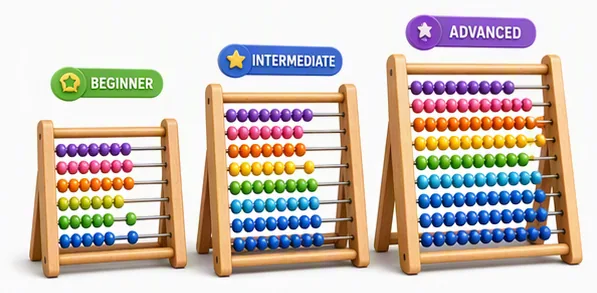
| Phase | Typical levels | Typical time | What's covered |
|---|---|---|---|
| Foundation | 0 to 3 | About 10–14 months (Level 0 is short) | Parts of the abacus, showing numbers, direct +/−, small friends, big friends |
| Operations | 4 to 6 | About 9–12 months | Mixed friends, multi-digit sums, multiplication, then division |
| Mental maths | 7 to 9+ | About 9–12 months or more | Anzan with no abacus, decimals, longer lists, speed work, flash anzan |
Level by level
| Level | Main topics |
|---|---|
| 0 | Holding the abacus, finger use (thumb up, index down), numbers 0–99 |
| 1 | Direct adding and subtracting, single and double digits |
| 2 | Small friends (make 5) |
| 3 | Big friends (make 10), carrying and borrowing |
| 4 | Mixed friends, 3-digit sums, first mental work |
| 5 | Multiplication (2 digits × 1 digit, then more) |
| 6 | Division by 1 digit, then 2 digits |
| 7 | Mental +/− of longer lists, decimals |
| 8 | Mental × and ÷ |
| 9+ | Speed and competitions, flash anzan, sometimes square roots |
You can try Level 1 to Level 5 style questions with the quick sums tool.
Level tests
Most centres hold a test at the end of each level. The test is usually timed and covers the level's sum types. Many centres expect high accuracy (often 80% or more) before a child moves up. Some also hold regional or national competitions.
Ask the centre what happens if a child doesn't pass. A good centre repeats weak topics rather than pushing a child forward.
Is your child ready for the next level?
- They can do most sums of the current type without looking at the teacher.
- They make few errors, even when a little rushed.
- They can explain which "friend" they used.
- They're still enjoying it, or at least not dreading class.
Does starting age change the path?
Older starters (8 or 9) may move through the early levels faster, because they already know number facts and can sit for longer. The later mental levels take practice time at any age. See the right age to start.