How Does an Abacus Work?
Each rod holds one digit from 0 to 9. You add and subtract by moving beads towards or away from the beam, rod by rod, using a few fixed rules.
Try it: a 7-rod soroban
Tap beads to move them, or type a number to see how it looks. Rods are labelled with Indian place values: O (ones), T (tens), H (hundreds), K (thousands), 10K, L (lakh) and 10L.
Showing digits 0 to 9
| Digit | Heaven bead | Earth beads up |
|---|---|---|
| 0 | Away | 0 |
| 1–4 | Away | 1 to 4 |
| 5 | Down | 0 |
| 6–9 | Down | 1 to 4 |
Place value on the rods
Choose one rod as ones, usually one with a unit dot. Every rod to its left is worth ten times more. To show 4,072 you set 4 on thousands, 0 on hundreds, 7 on tens and 2 on ones.
Because every rod works the same way, a child who can show 7 can show 70, 700 or 7 lakh. This link between beads and place value is what the abacus teaches most directly.
| Rod | Digit | Beads |
|---|---|---|
| Thousands | 4 | 4 earth beads up |
| Hundreds | 0 | Nothing |
| Tens | 7 | Heaven bead + 2 earth beads |
| Ones | 2 | 2 earth beads up |
Direct adding and subtracting
If the beads you need are free, just move them. For 3 + 5, push up 3 earth beads, then bring down the heaven bead. For 8 − 6, remove the heaven bead and one earth bead. Children start with sums like these.
Small friends and big friends
Sometimes the rod doesn't have the beads you need. Try 4 + 1: all four earth beads are already up. Instead of adding 1 directly, you add 5 and take away 4, because 1 and 4 are small friends (they make 5).
| To add… | Do this | To subtract… | Do this |
|---|---|---|---|
| +1 | +5 −4 | −1 | +4 −5 |
| +2 | +5 −3 | −2 | +3 −5 |
| +3 | +5 −2 | −3 | +2 −5 |
| +4 | +5 −1 | −4 | +1 −5 |
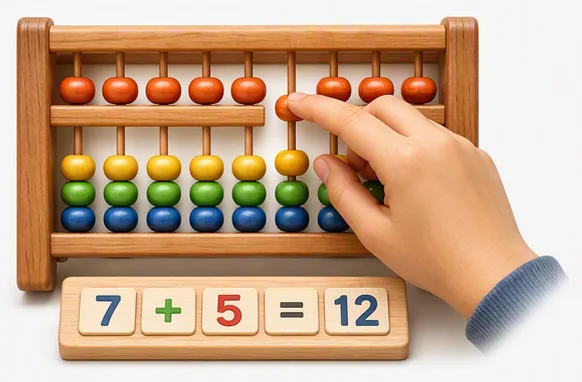
When a rod would go past 9, you carry to the next rod using big friends (pairs that make 10). For 7 + 5: add 10 on the tens rod and take away 5 on the ones rod. The answer is 12.
| To add… | Do this | To subtract… | Do this |
|---|---|---|---|
| +9 | +10 −1 | −9 | −10 +1 |
| +8 | +10 −2 | −8 | −10 +2 |
| +7 | +10 −3 | −7 | −10 +3 |
| +6 | +10 −4 | −6 | −10 +4 |
| +5 | +10 −5 | −5 | −10 +5 |
Mixed friends combine both. For 6 + 8 on the ones rod: you need +10 −2, but you can't take 2 directly from 6 (heaven bead + 1). So take 2 as −5 +3, then add 10 on the tens rod. The answer is 14.
Worked example: 47 + 38
- Set 47: tens rod 4, ones rod 7 (heaven bead + 2).
- Add the tens first: 4 + 3 on the tens rod. 3 can't go on directly, so use small friends: +5 −2. Tens rod shows 7.
- Add the ones: 7 + 8. Use big friends: −2 on ones, +1 on tens. Ones rod shows 5, tens rod shows 8.
- Read the answer: 85.
Abacus users work left to right, largest place first. That matches how numbers are read aloud and helps later with mental calculation.
Multiplication and division
Multiplication on a soroban uses times tables plus careful placement. For 23 × 4, you multiply 4 × 3 = 12 and 4 × 2 = 8 and add the partial products onto the right rods (12 + 80 = 92). Division works the other way, like long division: estimate, multiply, subtract, then move one rod right.
Most programmes introduce multiplication after about a year and division after that. See the abacus levels page for the usual order.
From beads to mental maths
Once the bead moves are automatic, learners start moving imaginary beads, often with small finger movements at first. This mental abacus (anzan) is what lets advanced students add long lists of numbers quickly. It usually takes one to two years of regular practice to reach this stage.