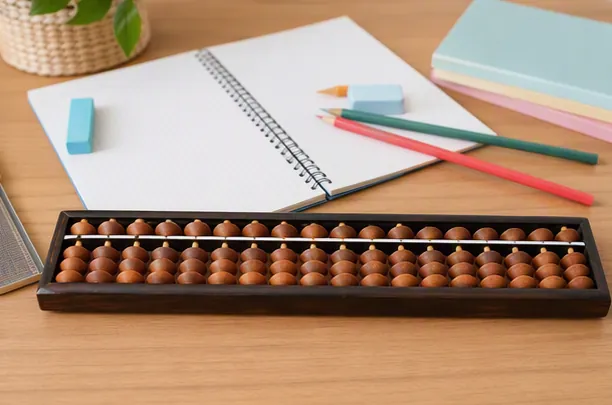
Division is sharing equally. This guide shows how to teach it in a sensible order: sharing with objects, exact division on the abacus, and remainders only when your child is ready.
By AbacusBrainy · Updated
What division means
Division splits a number into equal parts. 12 ÷ 3 is read "12 divided by 3". The number being shared (12) is the dividend, the number you divide by (3) is the divisor, and the answer (4) is the quotient. Children don't need these words at first.
Sharing and grouping
Sharing
Share 12 sweets equally between 3 children. Each child gets 4. This answers "How many does each one get?"
Grouping
Put 12 sweets into bags of 3. You fill 4 bags. This answers "How many groups are there?"
Both give 12 ÷ 3 = 4. Try both with real objects before using the abacus.
Division undoes multiplication
Every division fact comes from a multiplication fact. If your child knows 3 × 4 = 12, they also know 12 ÷ 3 = 4 and 12 ÷ 4 = 3. This is why times tables come first.
The simplest way to divide on the abacus is to take away the divisor again and again and count how many times you can do it. For 12 ÷ 3, set 12 and take away 3 until nothing is left.
Start
12
Take away 3 (1)
9
Take away 3 (2)
6
Take away 3 (3)
3
Take away 3 (4)
0
You took away 3 four times, so 12 ÷ 3 = 4. This is slow for big numbers, so next we divide one place at a time.
Step by step for bigger numbers
For bigger numbers, work from the left, one place at a time. Keep the number you are sharing on the abacus and write the answer digits on paper as you find them. In classes the answer is often placed on rods to the left of the number; the steps are the same.
Look at the left digit. If it is smaller than the divisor, look at the first two digits together.
Ask: how many times does the divisor fit? Use your times tables. Write that digit in the answer.
Multiply back and take that amount away on the abacus.
Bring down the next digit and repeat.
When no digits are left, check: answer × divisor should give the number you started with.
Exact answers and remainders
In an exact division nothing is left over: 84 ÷ 4 = 21. Many numbers don't share exactly. 17 ÷ 5 gives 3 groups of 5 (that's 15) with 2 left over. We write 17 ÷ 5 = 3 remainder 2, often shortened to 3 R 2.
Two rules for remaindersThe remainder is always smaller than the divisor; if it isn't, another group fits. And you can check: 3 × 5 + 2 = 17.
Teach exact division first. Most children find remainders easy once exact division is comfortable.
Worked examples
Each example adds one new idea. Keep the abacus for the amount still to share, and the answer on paper.
84 ÷ 4
Starter
8 ÷ 4: 2 groups of 4 make 8. Write 2 in the answer.
Take away 8 on the abacus: 8 − 8 = 0.
Bring down the next digit, 4: now we have 4.
4 ÷ 4: 1 groups of 4 make 4. Write 1 in the answer.
Take away 4 on the abacus: 4 − 4 = 0.
Answer: 84 ÷ 4 = 21.
Start
84
After step 2
4
After step 5
0
Step 1 on the abacus, bead by bead:
Before84
Action
− 80
After4
Green outline and arrow = a bead that moved. Faded beads are away from the bar.
Answer:84 ÷ 4 = 21 · Check: 21 × 4 = 84.
96 ÷ 4
Something left over
9 ÷ 4: 2 groups of 4 make 8. Write 2 in the answer.
Take away 8 on the abacus: 9 − 8 = 1.
Bring down the next digit, 6: now we have 16.
16 ÷ 4: 4 groups of 4 make 16. Write 4 in the answer.
Take away 16 on the abacus: 16 − 16 = 0.
Answer: 96 ÷ 4 = 24.
Start
96
After step 2
16
After step 5
0
Answer:96 ÷ 4 = 24 · Check: 24 × 4 = 96.
156 ÷ 6
Start with two digits
6 doesn't fit into 1, so start with the first two digits: 15.
15 ÷ 6: 2 groups of 6 make 12. Write 2 in the answer.
Take away 12 on the abacus: 15 − 12 = 3.
Bring down the next digit, 6: now we have 36.
36 ÷ 6: 6 groups of 6 make 36. Write 6 in the answer.
Take away 36 on the abacus: 36 − 36 = 0.
Answer: 156 ÷ 6 = 26.
Start
156
After step 3
36
After step 6
0
Answer:156 ÷ 6 = 26 · Check: 26 × 6 = 156.
208 ÷ 2
Zero in the answer
2 ÷ 2: 1 groups of 2 make 2. Write 1 in the answer.
Take away 2 on the abacus: 2 − 2 = 0.
Bring down the next digit, 0: now we have 0.
2 doesn't fit into 0, so write 0 in the answer.
Bring down the next digit, 8: now we have 8.
8 ÷ 2: 4 groups of 2 make 8. Write 4 in the answer.
Take away 8 on the abacus: 8 − 8 = 0.
Answer: 208 ÷ 2 = 104.
Start
208
After step 2
8
After step 4
8
After step 7
0
Answer:208 ÷ 2 = 104 · Check: 104 × 2 = 208.
47 ÷ 5
With a remainder
5 doesn't fit into 4, so start with the first two digits: 47.
47 ÷ 5: 9 groups of 5 make 45. Write 9 in the answer.
Take away 45 on the abacus: 47 − 45 = 2.
Answer: 47 ÷ 5 = 9 remainder 2 (9 R 2). 2 is smaller than 5, so no more groups fit.
Start
47
After step 3
2
Answer:47 ÷ 5 = 9 R 2 · Check: 9 × 5 + 2 = 47.
Try a guided sum
The tool walks you through one division, a place at a time. Your child answers each small step and the abacus shows what is still left to share.
0
The abacus shows what is still left to share.
Practise division
Ten questions at a time. Work each one on the abacus or on paper, then check. A wrong answer shows the right one and how to check it. Only answers right the first time count towards your learning journey.
Start at Level 1 of each operation. Move up after scoring 8 or more twice in a row. These are the same 5 levels as the worksheets for one operation and the game's operation choice.
Common mistakes
Dividing the wrong way round. 84 ÷ 4 is not the same as 4 ÷ 84. Read it as "84 shared into 4 groups".
Missing a zero in the answer. In 208 ÷ 2, 2 doesn't fit into 0, so the answer needs a 0: 104, not 14.
A remainder that is too big. If the remainder is as big as the divisor, or bigger, one more group fits.
Not checking. Multiply the answer by the divisor and add any remainder. You should get the number you started with.
Forgetting what was left over. In 96 ÷ 4, the 1 ten left over joins the 6 ones to make 16. Say it out loud.
Tips for parents
Share real things first: sweets, coins or pencils into equal groups.
Use the words "shared into" and "groups of" until the ÷ sign makes sense.
Keep to answers with no remainder at first. ÷ Levels 1 to 4 of the practice never have a remainder.
Ask your child to check each answer by multiplying back. It builds the habit early.
Introduce remainders with objects: 7 sweets for 2 children leaves 1 over.