Step-by-Step Guidance: Teach Your Child the Abacus
You don't need to be a maths teacher to start. Follow these 12 steps in order, practise a little each day, and use the free tools on this site at each stage.
Your learning journey
0% explored
- Read the guide →
Understanding the abacus
Read a beginner guide all the way through.
- Read What is an abacus or the beginner tutorial
- Play Set the number →
Numbers and place value
Set numbers on the abacus correctly.
- 0 of 5 numbers set correctly
- Practise + →
Addition (+)
Learn it with a guided sum, then practise.
- Finish a guided + sum
- 0 of 8 correct additions
- Practise − →
Subtraction (−)
Learn it with a guided sum, then practise.
- Finish a guided − sum
- 0 of 8 correct subtractions
- Learn × →
Multiplication (×)
Learn it with a guided sum, then practise.
- Finish a guided × sum
- 0 of 8 correct multiplications
- Learn ÷ →
Division (÷)
Learn it with a guided sum, then practise.
- Finish a guided ÷ sum
- 0 of 8 correct divisions
- Open the practice tools →
Regular practice
Practise on different days. Short sessions add up.
- 0 of 3 days with practice
- Make a worksheet →
Worksheets
Print a sheet and work through it on paper.
- Print a worksheet
- Play the game →
Practice Game
Finish a full round of ten questions.
- Finish a 10-question round
- Read the steps →
Parent guidance
Read this guidance page through.
- Read the step-by-step guidance
The 12 steps
Each step says what to teach, how to practise together and when to move on. Most families spend a few sessions on the early steps and longer on the later ones. Go at your child's pace.
Step 1
Start with understanding the abacus
- What to teach
- Let your child hold the abacus and move the beads freely. Explain that it is a tool for showing numbers, and that a bead counts only when it touches the middle bar (the beam).
- Practise together
- Clear the abacus together by pushing every bead away from the beam. Take turns moving one bead to the beam and back.What is an abacusTutorial step 1Is abacus useful?
- Move on when
- Your child can show you a cleared abacus and point to a bead that is counting.
Step 2
Learn the abacus parts and place values
- What to teach
- Name the parts: frame, rods, beam, the upper bead (worth 5) and the four lower beads (worth 1 each). Then show that each rod is a place: ones on the right, tens next, then hundreds.
- Practise together
- Point to a rod and ask "Which place is this?" Then swap: your child points and you answer.Parts of an abacusPlace value on the rods
- Move on when
- Your child can name the ones, tens and hundreds rods and say what each bead is worth.
Step 3
Learn how numbers are shown
- What to teach
- Show 0 to 9 on the ones rod: 1 to 4 with lower beads, 5 with the upper bead, 6 to 9 with both. Then show two-digit numbers such as 23 and 47 across two rods.
- Practise together
- Say a number and let your child set it. Then set a number yourself and let your child read it aloud.Digits 0 to 9Tutorial step 3
- Move on when
- Your child reads and sets 0 to 9 without counting every bead one by one.
Step 4
Practise forming numbers
- What to teach
- Build speed and accuracy in setting numbers, first on one or two rods, then on three.
- Practise together
- Play Set the number for ten rounds. Start with 1 or 2 rods and add a rod when it feels easy.Set the numberPractice abacus
- Move on when
- Your child gets 8 out of 10 or more with two rods.
Step 5
Learn addition (+)
- What to teach
- Start with direct sums where the beads you need are free, such as 3 + 5. Then teach the small friends (pairs that make 5) and the big friends (pairs that make 10), one at a time.
- Practise together
- Show one worked example from the guide slowly, saying each move out loud. Do a guided + sum together, then let your child practise + Level 1 alone.Addition and subtraction guideGuided + sum+ practice+ worksheet
- Move on when
- Your child gets 8 or more right at + Level 1 and can tell you which friend they used.
Step 6
Learn subtraction (−)
- What to teach
- Subtraction is taking beads away from the beam. Start with direct sums such as 8 − 6, then use the friend rules in reverse: −2 is done as −5 +3. Borrowing is the big-friend rule for taking away: −5 is done as −10 +5.
- Practise together
- Work through the subtraction examples in the guide, do a guided − sum together, then practise − Level 1 and − Level 2.Subtraction examplesGuided − sum− practice− worksheet
- Move on when
- Your child is as comfortable taking away as adding, including borrowing at − Level 2.
Step 7
Learn multiplication (×)
- What to teach
- Explain multiplication as equal groups and repeated addition: 3 × 4 = 4 + 4 + 4. Learn a few times tables at a time. Then multiply a two-digit number by a one-digit number, one rod at a time.
- Practise together
- Do a guided × sum together, then practise × Level 1.Multiplication guideGuided × sum× practice× worksheet
- Move on when
- Your child knows the tables they are using and can finish a guided sum with few hints.
Step 8
Learn division (÷)
- What to teach
- Explain division as sharing equally and as making equal groups. Show that it undoes multiplication: 12 ÷ 3 = 4 because 3 × 4 = 12. Stay with answers that have no remainder until they feel easy; remainders come later.
- Practise together
- Do a guided ÷ sum, then practise ÷ Level 1. Check each answer by multiplying back.Division guideGuided ÷ sum÷ practice÷ worksheet
- Move on when
- Your child can divide a two-digit number by a one-digit number and check the answer with ×.
Step 9
Practise with the interactive abacus and tools
- What to teach
- Strengthen one operation at a time, then mix them, so your child has to choose the right method for each sum.
- Practise together
- Use Practice by operation for + − × ÷ one at a time, and the mixed quick sums once your child knows several operations. Ten questions is enough for one sitting.Practice by operationMixed quick sumsPractice abacus
- Move on when
- Your child can work through a set alone and asks for help only with new types of sum.
Step 10
Use worksheets for regular practice
- What to teach
- Paper practice builds a steady routine and works away from the screen.
- Practise together
- Print a sheet for the operation your child is working on, at the same level as their practice. Set a timer for 10–15 minutes and mark it together with the answer key.Worksheets+ sheets− sheets× sheets÷ sheets
- Move on when
- Most of the sheet is right, and mistakes get fixed by redoing the sum slowly.
Step 11
Use the Practice Game for reinforcement
- What to teach
- A short round once or twice a week shows what has stuck. Under Operations, choose All for the usual mix, or +, −, × or ÷ to play only the operation your child is learning.
- Practise together
- Play one 10-question round. Easy, Medium and Hard match the operation's levels in Practice by operation. Look at the review together and redo the wrong ones on the abacus.Practice GameChoosing an operation
- Move on when
- Your child scores 8 out of 10 or more at the current game level.
Step 12
Move gradually to harder levels
- What to teach
- Increase one thing at a time: bigger numbers, more rows, or a new operation. Later, try a few sums by picturing the abacus (mental abacus).
- Practise together
- Move up a level after two sessions with 8 out of 10. If many mistakes appear, go back a level for a few days. That's normal.Abacus levelsFrom beads to mental maths
- Move on when
- There's no finish line. Keep sessions short and enjoyable.
Tips for teaching your own child
- Practise regularly, in short sessions. Ten to fifteen minutes a day works better than one long session a week. Stop while it's still fun.
- Aim for understanding, not memorising. Ask "Why did you move that bead?" If your child can explain the move, they understand it. Speed comes later.
- Show first, then let your child try. Do one example slowly while saying each move. Do the next one together. Then let your child do one alone while you watch.
- Correct mistakes patiently. Point to the rod where it went wrong and redo that sum slowly together. Mistakes show you what to practise next.
- Enjoy the time together. Sit beside your child, take turns, and let them set numbers for you to read. The time you share matters as much as the sums.
- Keep a routine. The same time each day, such as after school or before dinner, turns practice into a habit.
- Praise the method. "You used a big friend there" helps more than "That was fast".
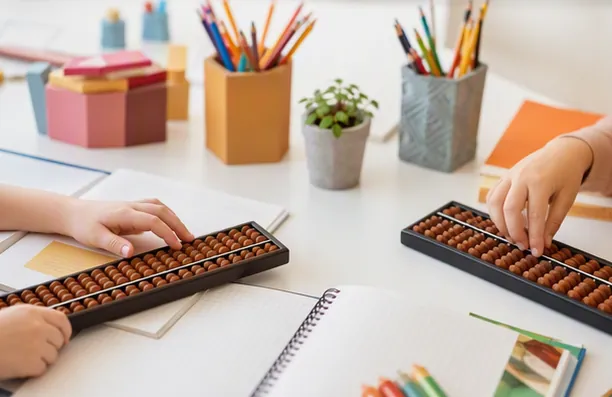
A 15-minute session
| Time | What to do |
|---|---|
| 2 min | Warm up: set and clear five numbers |
| 3 min | New idea: you show one example slowly |
| 5 min | Together, then alone: a few sums, with your child leading |
| 3 min | Fix mistakes: redo the wrong sums on the abacus |
| 2 min | Finish with something easy, or one game question |
Do you need a class?
Not to begin. With the explanations, tools and worksheets on this site, many parents teach the early levels at home. AbacusBrainy is free: we share learning resources and guidance, and we don't sell courses or classes. If your child would benefit from a teacher or a group, or you'd like more structure later, a class is a good option too. See what to ask a class.
Ready? Start with the beginner tutorial, or jump to the step your child is on.