Is Abacus Useful or Not? An Honest Answer for Parents
Abacus can be useful, mainly for arithmetic. With regular practice it helps many children understand place value and calculate faster and more accurately. It is not a shortcut to higher marks or a higher IQ, and it doesn't replace school maths.
What is an abacus?
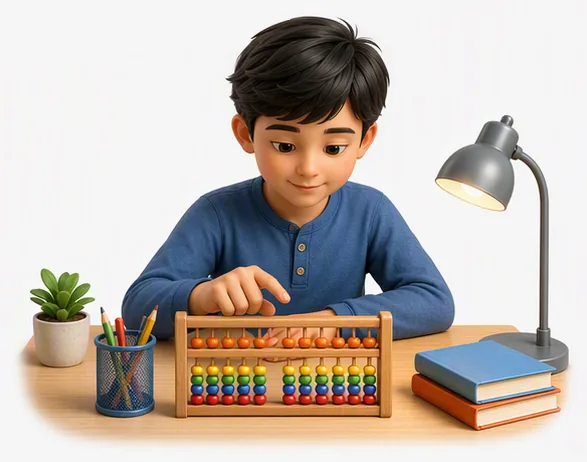
An abacus is a frame of beads on rods. Each rod stands for a place: ones, tens, hundreds and so on. Children show numbers by moving beads, and they add, subtract, multiply and divide by moving beads in fixed patterns. Most classes in India use the Japanese soroban, with one bead worth 5 above the bar and four beads worth 1 below. More about what an abacus is.
Is abacus actually useful?
For many children, yes, in a specific way. The abacus turns numbers into something a child can see and touch. Each bead move matches a step in a sum, so place value and carrying stop being abstract rules. After months of practice, many children add and subtract faster and with fewer mistakes.
The largest study so far, a randomised trial with about 200 children in Vadodara, found that children who learned mental abacus for about three years did better on arithmetic tests than children who had extra regular maths lessons instead. That is a real but specific benefit: arithmetic.
What skills can children practise?
| Skill | What it means | How sure are we? |
|---|---|---|
| Place value | Each rod is a place, so ones, tens and hundreds become visible | What it directly trains |
| Number sense | Seeing how numbers split into 5s and 10s (the friends) | What it directly trains |
| Calculation (+ − × ÷) | Fast, accurate sums | Supported after long practice |
| Mental calculation | Picturing the abacus to calculate in the head | Comes with 1–2 years or more of practice |
| Focus during a task | Staying with a short set of sums | Often reported, less proven |
How mental calculation develops
At first, children need the real abacus. After many weeks the bead patterns become familiar, and children start to picture the abacus and move imaginary beads, often with small finger movements. With one to two years of regular practice, some children can add long lists of numbers in their head. Not every child gets this far, and that's fine: the earlier skills are useful on their own.
Does every child benefit in the same way?
No. How much a child gains depends on a few things:
- Readiness. Children who can count to 20 and sit for a short lesson usually find it easier. Many start between 5 and 7.
- Regular practice. Short sessions over months make the difference. A few weeks rarely does.
- How the child learns. In the Vadodara trial, children who started with stronger spatial memory gained more. Some children love the beads; others find them dull.
- Support. Encouragement and someone to practise with, at home or in a class, keep children going.
What the research does and doesn't show
What it shows
- Better arithmetic after about three years of mental abacus lessons (Vadodara trial, India).
- Abacus experts calculate differently, using brain areas for visual and spatial thinking (a small study in Japan).
What it doesn't show
- Any change in general thinking skills such as working memory or attention (Vadodara trial).
- A clear advantage after one year in a US school trial, where children practised less and many found it hard.
- Any good evidence that abacus raises IQ.
Abacus does not replace school maths
Abacus is arithmetic practice. School maths is much wider: number concepts, reasoning, word problems, geometry, measurement, fractions and data. Children still need to understand why methods work, explain their thinking and solve problems. Use abacus alongside school maths, never instead of it. Abacus and school maths compared.
What abacus cannot promise
- A higher IQ. There is no good evidence for this.
- Better marks across the board. It may help with the arithmetic parts of maths, not with everything.
- Academic success. Many things matter more: good teaching, reading, sleep and steady effort.
- Quick results. The gains in the research took years, not weeks.
If a class promises these, ask what evidence they have. See claims to be careful about.
Strengths and limitations
Strengths
- Makes place value visible and hands-on
- Builds fast, accurate arithmetic with practice
- Clear steps and levels show progress
- Cheap to start at home with a student abacus and free tools
- Easy to practise together as a family
Limitations
- Needs regular practice for months and years
- Covers arithmetic only
- Some children find it repetitive
- Working left to right can feel different from school methods at first
Who may find it useful?
- Children of about 5 to 10 who enjoy hands-on activities
- Children who find place value or carrying confusing and need to see it
- Families who can practise for 10–15 minutes on most days
It may be less useful right now if your child is anxious about maths and dislikes the beads, or is behind in the basics of school maths. In that case, focus on school topics first, or keep abacus as a short, playful extra. See the right age to start and how abacus levels progress.
Our honest conclusion
Abacus is a useful tool for arithmetic, not a magic one. If your child enjoys it and you can keep practice short and regular, it can build real number skills and give you good time together. Try the early levels at home for a few weeks and watch two things: is your child enjoying it, and does it make sense to them? If yes, keep going. If not, it's fine to pause or choose something else.